PAHO/WHO Sodium Reduction
Analysis of Sodium and Trans Fat in Latin America
The L’Abbé Lab has collaborated with the Pan American Health Organization/World Health Organization (PAHO/WHO) to support regional efforts to reduce sodium intake and eliminate industrially produced trans fatty acids (iTFA) from the food supply.
In 2022, the L’Abbé Lab was contracted by PAHO to provide technical support for data collection and analysis of sodium and trans fatty acid contents in processed and ultra-processed packaged food products in Argentina, Costa Rica, Panama, and Peru. The lab also prepared a regional update on sodium levels in packaged foods in relation to PAHO Regional Sodium Reduction Targets and WHO global sodium benchmarks.
This work provided critical evidence to support the adoption and implementation of the updated PAHO Regional Sodium Reduction Targets, WHO global sodium benchmarks, and the WHO REPLACE technical package for the elimination of industrially produced trans fatty acids.
In 2025, the L’Abbé Lab continued this work through PAHO-supported monitoring of sodium and iTFA content in packaged food products in Argentina, Bolivia, and Suriname.
Reports & Publications
Monitoring sodium content in packaged foods sold in the Americas and compliance with the updated regional sodium reduction targets. PLOS ONE. 2025 Apr 3;20(4):e0304922.
Final Regional Report: Technical support for data collection and analysis of sodium and trans fat contents in processed and ultra-processed food products in Argentina, Bolivia, and Suriname. Washington, D.C.: Pan American Health Organization; June 2025. 110 p.
Technical Report: Monitoring sodium and iTFA content in packaged products in Argentina, Bolivia and Suriname. Washington, D.C.: Pan American Health Organization; June 2025. 5 p.
Final Regional and Technical Reports submitted to PAHO. Washington, D.C.: Pan American Health Organization; December 5, 2022. 94 p.
____________________________________________________________________________________
Technical Advisory Group

In 2009, PAHO launched the initiative “Cardiovascular Disease Prevention through Population-wide Dietary Salt Reduction,” with the broader goal of reducing population dietary sodium intake in Member States and supporting progress toward the WHO global target of a 30% relative reduction in mean population sodium intake by 2025.
Dr. Mary L’Abbé has served as a member of the Technical Advisory Group supporting this regional initiative and chaired Phase 3 of the group’s work. During Phase 3, the PAHO Regional Sodium Reduction Targets were expanded and updated to lower target values for many food categories and add new food categories where targets were warranted.
The L’Abbé Lab, as the WHO Collaborating Centre on Nutrition Policy for Chronic Disease Prevention, collaborated with PAHO/WHO on this update to the Regional Sodium Reduction Targets.
Reports
Pan American Health Organization. WHO/PAHO Technical Advisory Group on Cardiovascular Disease Prevention Through Dietary Salt/Sodium Reduction: Final Report Phase 3. Washington, D.C.: PAHO; 2024.
Pan American Health Organization. Updated PAHO Regional Sodium Reduction Targets. Washington, D.C.: PAHO; 2021.
____________________________________________________________________________________
International Development Research Centre Projects
Scaling Up and Evaluating Salt Reduction Policies and Programs in Latin American Countries
Completed in 2020, this project addressed high blood pressure in Latin America by supporting research to strengthen and expand existing sodium reduction programs and inform the development of new programs in Argentina, Brazil, Costa Rica, Paraguay, and Peru.
The project generated journal articles, technical reports, user guides, and policy briefs related to sodium levels in packaged foods, food labelling, policy implementation, and tools to support regional sodium reduction efforts.
Implementation of a Population-wide Program to Reduce Salt and Sodium Consumption in Costa Rica
 Completed in 2020, this project aimed to produce evidence and tools to support policies and interventions to reduce sodium intake in Costa Rica. The research team provided scientific evidence to identify major dietary sources of sodium in the Costa Rican diet and examined students’ knowledge, perceptions, and behaviours related to sodium, food labelling, and health.
This evidence served as an evaluation baseline for Costa Rica’s National Plan for Salt Intake Reduction and provided lessons that may support sodium reduction initiatives in other countries in the region.
____________________________________________________________________________________
INFORMAS
The International Network for Food and Obesity/non-communicable diseases Research, Monitoring and Action Support (INFORMAS) is a global network of public-interest organizations and researchers that monitors, benchmarks, and supports public and private sector actions to create healthier food environments and reduce obesity, non-communicable diseases, and related inequalities.
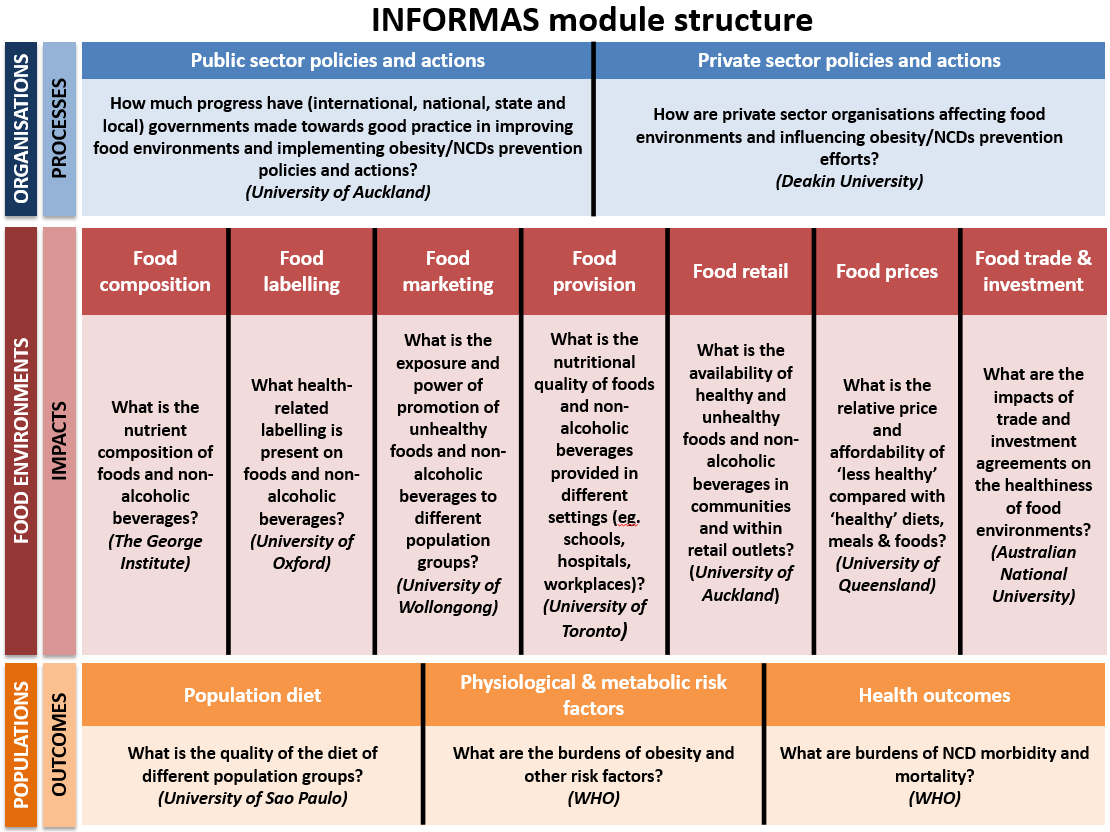
The INFORMAS framework includes modules that monitor public and private sector policies and actions, key characteristics of food environments, and population-level outcomes, including diet quality, risk factors, and non-communicable disease morbidity and mortality. These standardized methods support consistent monitoring across countries while allowing for stepwise approaches to data collection and analysis.
The L’Abbé Lab has contributed to INFORMAS-related research in Canada across several domains, including public sector policies and actions, private sector policies and actions, food labelling and health claims, food composition, and food prices. Related work on food retail and food promotion has also been conducted in collaboration with Canadian research groups.
INFORMAS Canada released a national report in 2025, An in-depth look at Canada’s food environments, which brings together evidence from studies conducted across Canada between 2020 and 2024 to benchmark the status of food environments and identify priority areas for policy action.
Dr. L’Abbé and collaborators have also contributed to international INFORMAS-related work, including the Measurement, Evaluation, Accountability, and Leadership Support for NCDs project, known as MEALS4NCDs, in Ghana. This project adapted INFORMAS methods to measure and support public sector actions that create healthier food marketing, retail, and provisioning environments for Ghanaian children.
For more information, visit INFORMAS Global and INFORMAS Canada.
____________________________________________________________________________________
Sanofi-Pasteur University of Toronto / Université Paris-Descartes Collaborative Feasibility Grant
Comparison of two Front of Pack food rating systems for identifying foods consistent with Canada’s Food Guide and Guidelines for diabetes prevention and management
Poor diet is a major risk factor for diabetes, cardiovascular disease, and cancer. Dietary guidelines, including Canada’s Food Guide and Diabetes Canada Clinical Practice Guidelines, aim to improve dietary intakes by encouraging foods and nutrients such as fruits, vegetables, and fibre, while limiting nutrients of public health concern such as sodium, sugars, and saturated fat.
Front-of-package nutrition labelling has been implemented or proposed in many jurisdictions to help consumers identify healthier food choices. In Canada, the front-of-package nutrition symbol is mandatory for prepackaged foods that meet or exceed set levels for saturated fat, sugars, or sodium.
This Canadian-French collaborative project evaluated the classification of foods using the nutrient profiling systems underpinning the Canadian “high in” front-of-package nutrition symbol and the French Nutri-Score system. The Canadian system focuses on nutrients to limit, while Nutri-Score considers both nutrients to limit and components to encourage.


Using large Canadian food databases, the project compared how well each system identified foods consistent with Canada’s Food Guide and Diabetes Canada guidance. The project also evaluated whether diets in nationally representative Canadian and French population samples aligned with these dietary recommendations.
Findings from this collaborative research were published in European Journal of Nutrition in 2022, with related work examining the alignment of Canadian front-of-package labelling regulations with other front-of-package labelling systems and dietary guidelines published in Frontiers in Public Health in 2023.
Related Publications:
Paper L, Ahmed M, Lee JJ, Kesse-Guyot E, Touvier M, Hercberg S, Galan P, Salanave B, Verdot C, L’Abbé MR, Deschamps V, Julia C. Cross-sectional comparisons of dietary indexes underlying nutrition labels: Nutri-Score, Canadian “high in” labels and Diabetes Canada Clinical Practices (DCCP). European Journal of Nutrition. 2022.
Lee JJ, Ahmed M, Julia C, Ng AP, Paper L, Lou WY, L’Abbé MR. Examining the diet quality of Canadian adults and the alignment of Canadian front-of-pack labelling regulations with other front-of-pack labelling systems and dietary guidelines. Frontiers in Public Health. 2023;11:1168745.