The L’Abbé Lab develops and evaluates consumer-facing tools that help translate complex nutrition information into formats that are easier to understand and use. These tools are designed to support research, public health education, and healthier food choices by helping users interpret food labels, nutrient profiling systems, and dietary sources of nutrients of public health concern.
_______________________________________________________
FoodFlip®

FoodFlip® is a smartphone app developed by the L’Abbé Lab to help consumers access easy-to-understand nutrition information for packaged foods and beverages. Users can scan a product barcode or search for a product to view simplified nutrition information based on nutrient profiling algorithms.
FoodFlip® was designed to help consumers compare products and better understand the nutritional quality of packaged foods and beverages. The app draws on the L’Abbé Lab’s food composition and label database, which includes information such as nutrient levels, ingredients, product images, brand names, marketing features, nutrition claims, and company information for foods sold in Canada.
FoodFlip® has also been used in research examining how different formats for presenting nutrition information influence consumer perceptions, understanding, and opinions.
Related Publication:
A randomized controlled trial examining consumers’ perceptions and opinions on using different versions of a FoodFlip© smartphone application for delivery of nutrition information. Ahmed M, Schermel A, Lee J, Weippert M, Franco-Arellano B, L’Abbé MR. International Journal of Behavioral Nutrition and Physical Activity. 2020.
[Find FoodFlip® in the App Store]
 _______________________________________________________
Global Nutrient Profiling Calculator Tool©
The Global Nutrient Profiling Calculator Tool© is a research tool developed by the L’Abbé Lab to support the application of nutrient profiling models to food and beverage products. Nutrient profiling models are used to assess the nutritional quality of foods and can inform research on front-of-package labelling, food marketing restrictions, product reformulation, and other nutrition policies.
The calculator tool allows users to enter nutrition information and apply selected nutrient profiling models using L’Abbé Lab-developed algorithms and instructions. Model-specific documentation is included to support consistent application and interpretation.
This tool is available upon request for eligible research purposes and may require a data sharing or licensing agreement.
Related Publications:
The Global Nutrient Profiling Calculator Tool© builds on the L’Abbé Lab’s research applying and comparing nutrient profile models for food policy, front-of-package labelling, food marketing restrictions, and food supply monitoring. For example:
- Global nutrient profile models for nutrition policy
Labonté MÈ, Poon T, Gladanac B, Ahmed M, Franco-Arellano B, Rayner M, L’Abbé MR. Advances in Nutrition. 2018;9(6):741-788. - Comparing nutrient profile models for food marketing restrictions
Labonté MÈ, Poon T, Mulligan C, Bernstein JT, Franco-Arellano B, L’Abbé MR. American Journal of Clinical Nutrition. 2017;106(6):1471-1481. - Traffic light labelling and potential health impacts in Canada
Labonté MÈ, Emrich TE, Scarborough P, Rayner M, L’Abbé MR. PLOS ONE. 2019;14(12).
_______________________________________________________
Salt Calculator

Dr. JoAnne Arcand, a former postdoctoral fellow in the L’Abbé Lab, co-developed the Sodium Calculator, an online dietary assessment tool designed to help the public and clinicians estimate dietary sodium intake and identify major sources of sodium in the diet.
Calculate your sodium intake here.
Related Publication:
Development of the Sodium Calculator
Arcand J, Abdulaziz K, Bennett C, L’Abbé MR, Manuel DG. Applied Physiology, Nutrition, and Metabolism. 2014;39(3):413-421.
_______________________________________________________
OneSweetApp
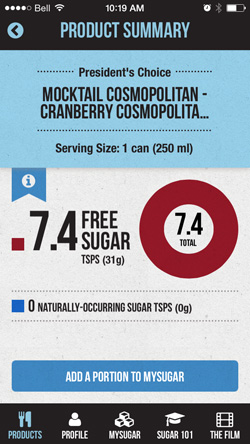
OneSweetApp was developed in collaboration with Plank to help consumers identify total and free sugar amounts in packaged foods. The app was designed to allow users to scan barcodes or search a database to better understand sources of free sugars in the food supply.
Free sugars include added sugars as well as sugars naturally present in honey, syrups, fruit juices, fruit juice concentrates, and similar ingredients. These sugars can be difficult for consumers to identify using the Nutrition Facts table alone.
Related Publication:
Free sugar content of Canadian packaged foods and beverages
Bernstein JT, Schermel A, Mills CM, L’Abbé MR. Nutrients. 2016;8(9).