
Healthy eating in childhood is important for growth, development, learning, and long-term health. Children’s diets are shaped by many factors, including family and household environments, school food environments, food marketing, food availability, food prices, and broader nutrition policies.
The L’Abbé Lab conducts research to better understand the diets of Canadian children and adolescents, the food environments that influence children’s food choices, and the policies that can support healthier eating in Canada and globally.
Our Research Goals
The goal of child nutrition research at the L’Abbé Lab is to generate evidence that can inform policies, programs, and interventions to improve children’s diets and health.
Our research focuses on:
- assessing the dietary intakes and diet quality of Canadian children and adolescents;
- identifying top food sources of energy, sodium, sugars, saturated fat, and other nutrients of concern;
- evaluating school food environments, school food programs, and foods available in and around schools;
- examining food and beverage marketing to children across packaged foods, restaurants, television, digital media, and online platforms;
- assessing how foods and beverages align with nutrition policies and nutrient profile models; and
- developing tools and methods to monitor children’s food environments and support healthier food policies.
Recent Studies
The L’Abbé Lab has con ducted studies on children’s dietary intakes, school food environments, school food programs, child-appealing packaged foods, unhealthy food and beverage marketing, and the nutritional quality of foods and beverages available to children.
Recent work has examined Canadian children’s energy and nutrient intakes at school, the top food categories contributing to these intakes, the nutritional quality of school food programs in Canada, implementation of Canada’s national school food policy, and the development of school food environment audit tools.
The lab has also conducted research on child-directed food and beverage marketing, including child-appealing packaged foods, the proportion of grocery and restaurant foods that would be restricted from marketing to children, the healthfulness of major food brands, and the use of artificial intelligence and computer vision to monitor unhealthy child-directed marketing at scale.
_______________________________________________________
School Food Environments and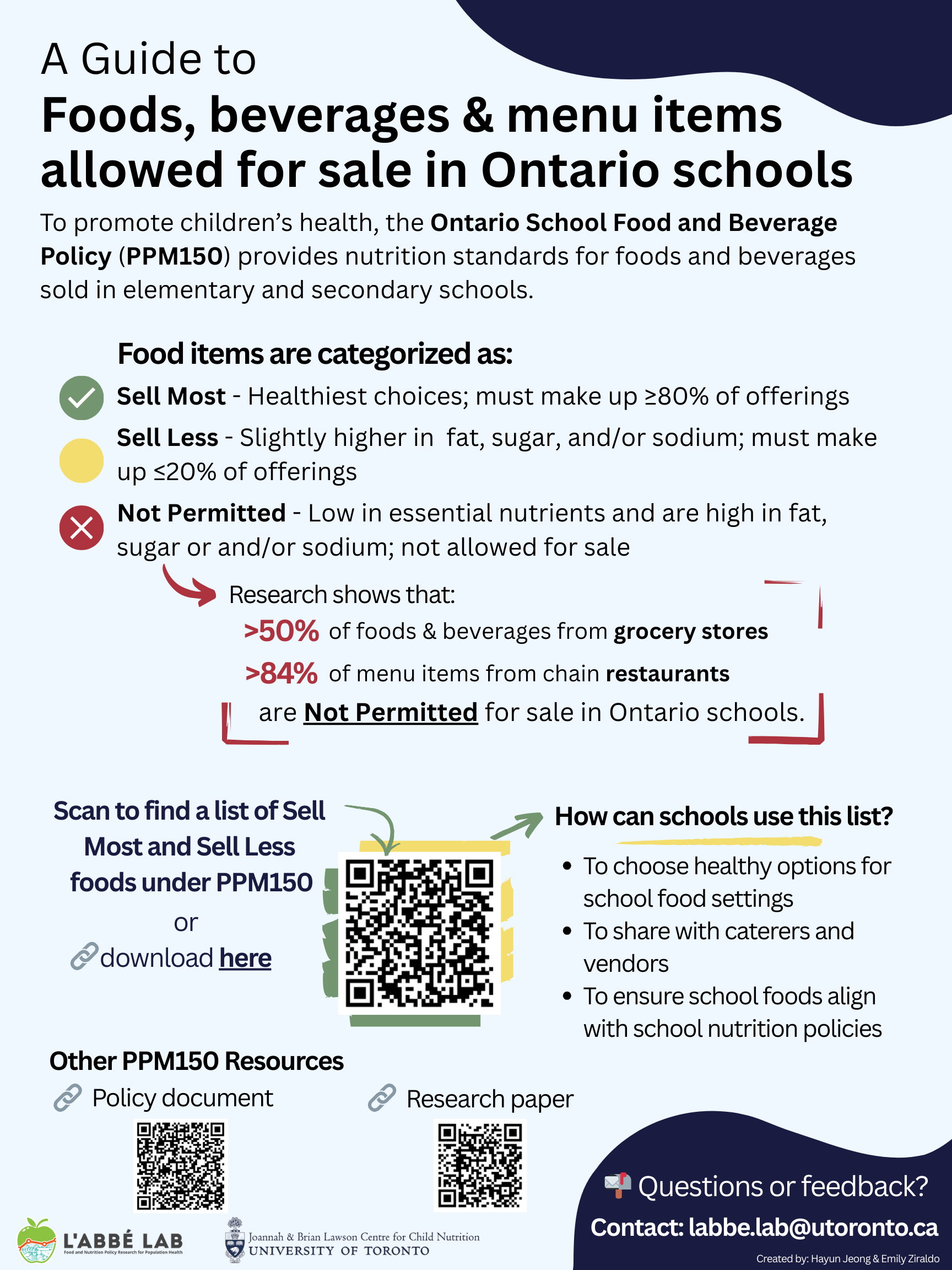 Dietary Intakes
Schools are an important setting for supporting healthy eating among children and adolescents. School food programs, foods brought from home, foods purchased at school, and foods available near schools can all influence children’s dietary intakes during the school day.
The L’Abbé Lab’s school food research examines what children and adolescents eat at school, the nutritional quality of school food programs, and how foods and beverages available in school-related settings align with nutrition guidelines and policies.
The infographic shown to the right highlights findings from our study on grocery and restaurant foods allowed for sale in Ontario schools.
Selected Publications
- Nutrient intakes of Canadian children and adolescents at school
Ziraldo E, Ahmed M, Mulligan C, Sellen D, L’Abbé M. Applied Physiology, Nutrition, and Metabolism. 2025;50:1-12. - Evaluating the nutritional quality of school food programs in Canada
Blais A, Ahmed M, L’Abbé MR, Sellen D, Malik V. Applied Physiology, Nutrition, and Metabolism. 2025. - Strengthening implementation of Canada’s national school food policy
Blais A, Organ B, Weber N, Ahmed M, L’Abbé M, Sellen D, Malik V. Canadian Journal of Public Health. 2025. - School food environment audit tool in Canada
Jeong H, Wedekind E, Selvarajah D, Ahmed M, McPherson C, Sellen DW, L’Abbé MR. BMC Public Health. 2025;25:3636. - Grocery and restaurant foods allowed for sale in Ontario schools
Ziraldo ER, Jeong H, Blais A, Ahmed M, Uji M, Yang Y, Malik V, Sellen D, L’Abbé MR. Applied Physiology, Nutrition, and Metabolism. 2025. - Canada-wide survey of school food programs
Blais A, Ahmed M, L’Abbé MR, Sellen D, Malik V. Applied Physiology, Nutrition, and Metabolism. 2024.
_______________________________________________________
Food and Beverage Marketing to Children
Food and beverage marketing can influence children’s food preferences, purchase requests, consumption patterns, and dietary quality. The L’Abbé Lab conducts research to assess the extent and healthfulness of food and beverage marketing directed at children and to inform policies that restrict unhealthy food marketing to children.
Our research has examined child-appealing marketing on packaged foods, television, digital media, company websites, and other platforms. Recent work has also used artificial intelligence and computer vision to detect and monitor unhealthy child-directed food and beverage marketing.
Selected Publications
- AI monitoring of child-directed food marketing
Hu G, Gross O, Ziraldo E, Mulligan C, Soberman D, Dewan M, Lewis K, Nomani R, Lu A, L’Abbé MR. EClinicalMedicine. 2025;89:103549. - Child-appealing foods and “high in” front-of-package labels
Jeong H, Mulligan C, Vergeer L, Lee JJ, L’Abbé MR. Public Health Nutrition. 2025. - Foods restricted from marketing to children
Jeong H, Mulligan C, Khan A, Vergeer L, L’Abbé MR. Nutrients. 2025;17(11):1828. - Healthfulness of major food brands
Vergeer L, Mulligan C, Jeong H, Khan A, L’Abbé MR. Public Health Nutrition. 2025;28(1):e17. - Child-appealing packaged foods in Canada
Mulligan C, Vergeer L, Potvin Kent M, L’Abbé MR. PLOS ONE. 2023;18(5):e0284350. - Children’s exposure to unhealthy food advertising
Potvin Kent M, Soares Guimarães J, Pritchard M, Remedios L, Pauzé E, L’Abbé M, Mulligan C, Vergeer L, Weippert M. BMC Public Health. 2023;23:555. - Child-targeted food advertising expenditures
Potvin Kent M, Pauzé E, Remedios L, Wu D, Soares Guimarães J, Pinto A, Bagnato M, Pritchard M, L’Abbé M, Mulligan C, Vergeer L, Weippert M. PLOS ONE. 2023;18(1):e0279275.
_______________________________________________________
Additional publications from the L’Abbé Lab can be found on our Publications page by filtering topics for “School Foods.”
Additional information on child nutrition research at the University of Toronto can be found on the website for the Joannah & Brian Lawson Centre for Child Nutrition.